Egyptian Art Banquet Scene From the Tombchapel of Nebamun Thebes His Wadi
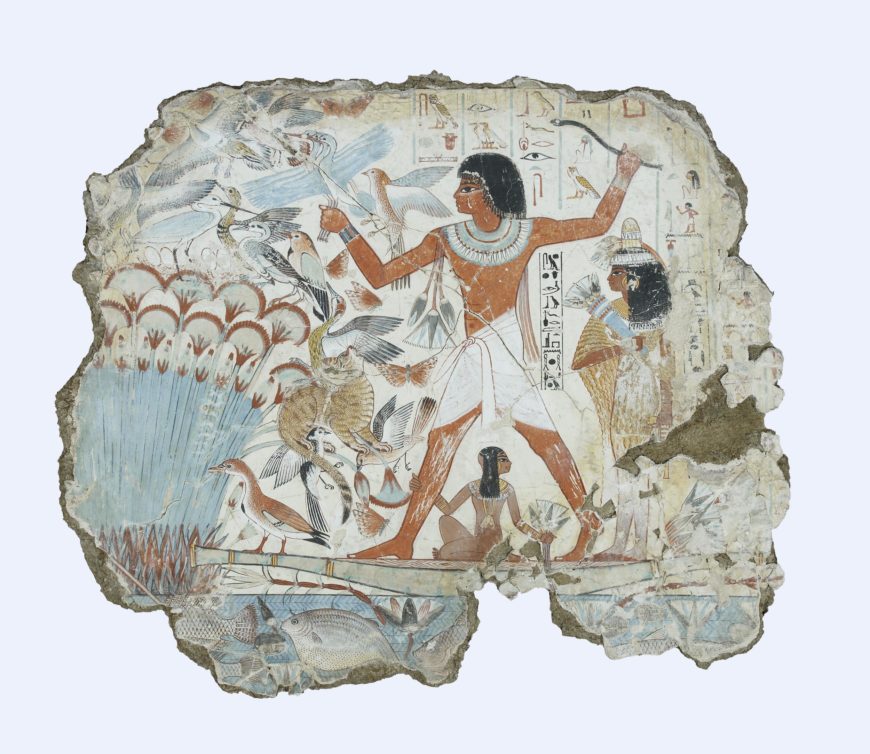
Nebamun fowling in the marshes, Tomb-chapel of Nebamun, c. 1350 B.C.E., 18th Dynasty, paint on plaster, 83 x 98 cm, Thebes © Trustees of the British Museum
Hunting in the marshes
Nebamun is shown hunting birds from a small boat in the marshes of the Nile with his wife Hatshepsut and their immature daughter. Such scenes had already been traditional parts of tomb-chapel ornamentation for hundreds of years and prove the dead tomb-owner "enjoying himself and seeing beauty," every bit the hieroglyphic explanation here says.
This is more than a simple image of recreation. Fertile marshes were seen every bit a identify of rebirth and eroticism. Hunting animals could represent Nebamun's triumph over the forces of nature equally he was reborn. The huge striding effigy of Nebamun dominates the scene, forever happy and forever young, surrounded by the rich and varied life of the marsh.
There was originally some other half of the scene which showed Nebamun spearing fish. This half of the wall is lost, apart from two old photographs of small fragments of Nebamun and his young son. The painters take captured the scaly and shiny quality of the fish.
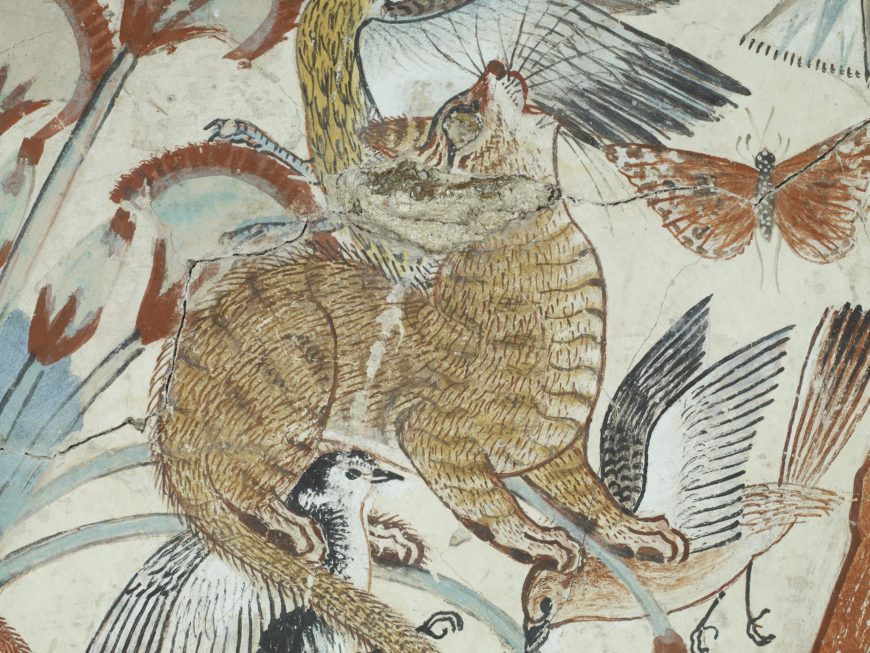
True cat communicable birds in the papyrus dodder (detail), from the Fowling in the Marshes, 18th Dynasty, Tomb of Nebamun, from the tomb of Nebanum, c. 1350 B.C.East., 18th Dynasty, paint on plaster, Thebes © The Trustees of the British Museum
A tawny cat catches birds among the papyrus stems. Cats were family pets, simply in artistic depictions like this they could also represent the Sun-god hunting the enemies of light and order. His unusual gilded heart hints at the religious meanings of this scene.
The artists have filled every space with lively details. The marsh is full of lotus flowers and Plain Tiger butterflies. They are freely and delicately painted, suggesting the pattern and texture of their wings.
Nebamun's Garden
Nebamun'south garden in the afterlife is not unlike the earthly gardens of wealthy Egyptians. The puddle is full of birds and fish, and surrounded by borders of flowers and shady rows of trees. The fruit trees include sycamore-figs, date-palms and dom-palms—the dates are shown with unlike degrees of ripeness.
On the right side of the pool a goddess leans out of a tree and offers fruit and drinks to Nebamun (now lost). The artists accidentally painted her peel red at first but so repainted it yellow, the right color for a goddess' peel. On the left, a sycamore-fig tree speaks and greets Nebamun as the owner of the garden; its words are recorded in the hieroglyphs.
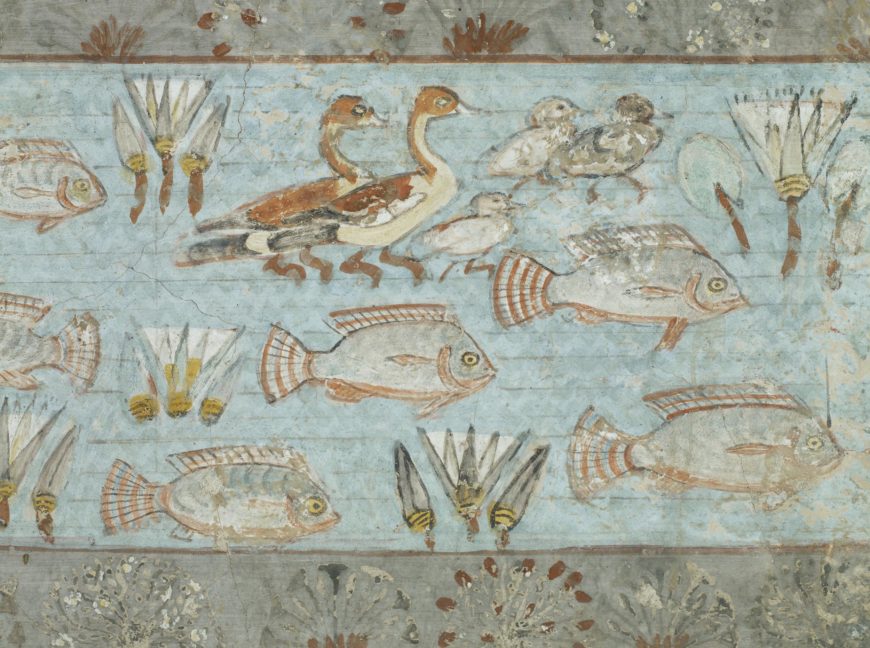
Puddle (particular) Nebamun's garden, Tomb-chapel of Nebamun, c.1350 B.C.E., 18th Dynasty, pigment on plaster, 64 cm high, Thebes, Egypt © Trustees of the British Museum
Hither the pool is shown from in a higher place, with three rows of trees bundled around its edges. The waves of the pool were painted with a darker blue paint; much of this has been lost, similar the greenish on the trees and bushes.
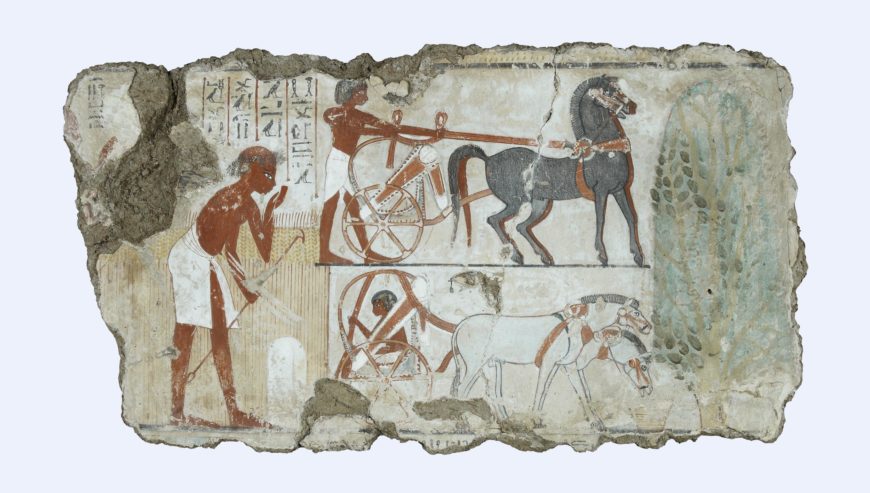
Surveying the fields for Nebamun, Tomb-chapel of Nebamun, c. 1350 B.C.East., 18th Dynasty, pigment on plaster, 106.7 ten 45.8 cm, Thebes, Egypt © Trustees of the British Museum
Surveying the fields
Nebamun was the accountant in charge of grain at the great Temple of Amun at Karnak. This scene from his tomb-chapel shows officials inspecting fields. A farmer checks the boundary marker of the field.
Nearby, two chariots for the political party of officials look under the shade of a sycamore-fig tree. Other smaller fragments from this wall are now in the Egyptian Museum in Berlin, Deutschland and show the grain being harvested and candy.
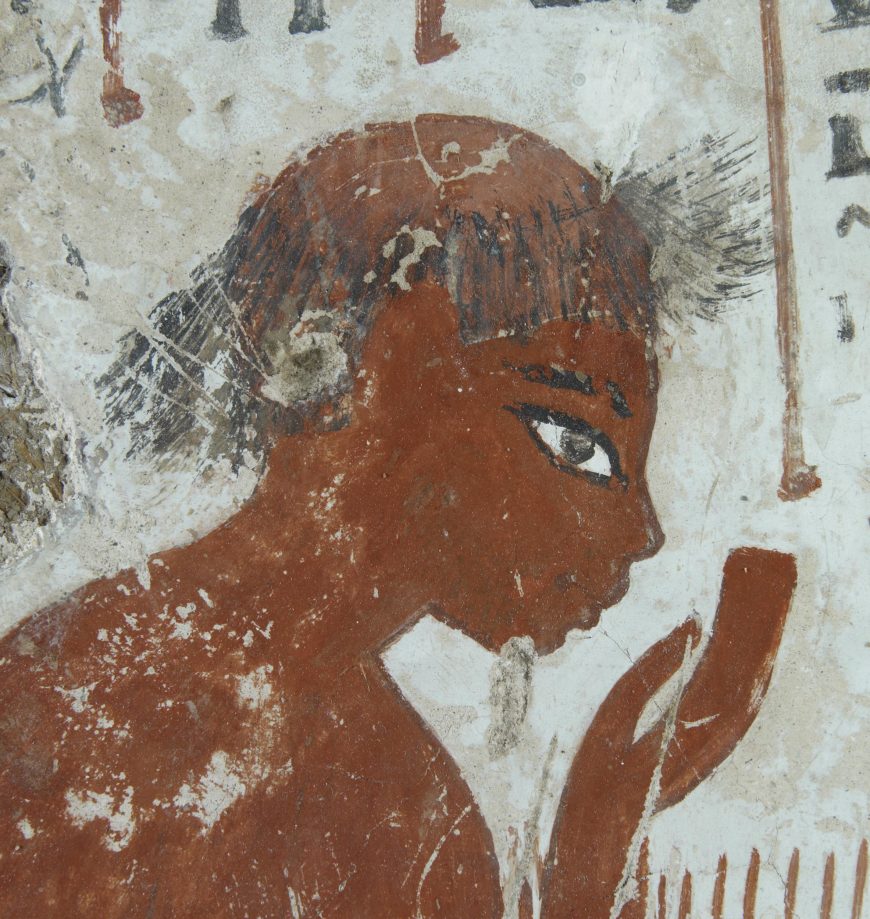
Erstwhile human assessing crops (detail), Surveying the fields for Nebamun, Tomb-chapel of Nebanum, c. 1350 B.C.Due east., 18th Dynasty, paint on plaster, whole fragment: 106.vii x 45.eight cm, Thebes © Trustees of the British Museum
The one-time farmer is shown balding, desperately shaven, poorly dressed, and with a protruding navel. He is taking an adjuration saying: "As the Bang-up God who is in the sky endures, the boundary-stone is verbal!"
"The Master of the Measurers of the Granary," (mostly lost) holds a rope busy with the caput of Amun's sacred ram for measuring the god'due south fields. After Nebamun died, the rope'south caput was hacked out, but later, perhaps in Tutankhamun's reign, someone clumsily restored it with mud-plaster and redrew it.
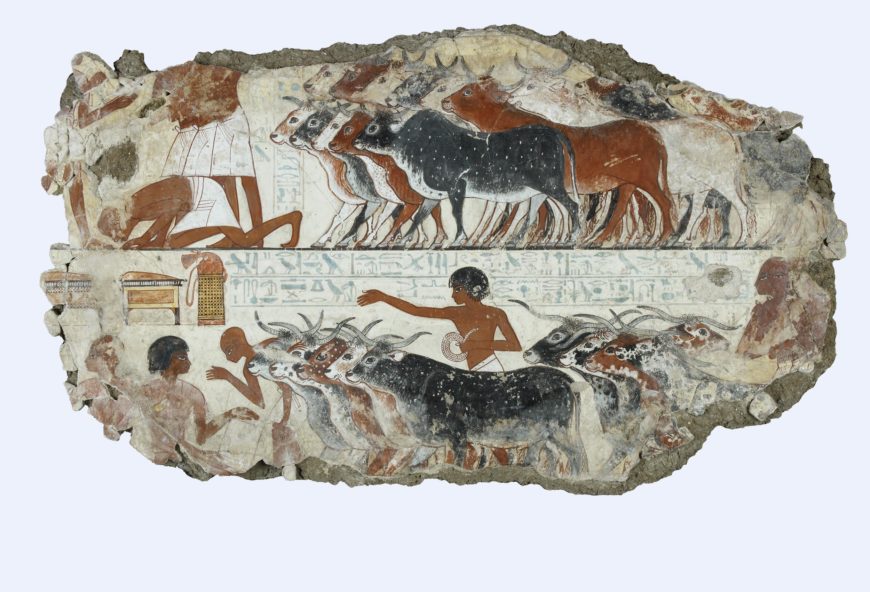
Nebamun's cattle, Tomb-chapel of Nebamun, c. 1350 B.C.Eastward., 18th Dynasty, paint on plaster, 58.5 x 10.5 cm, Thebes, Egypt © Trustees of the British Museum
Nebamun's cattle
This fragment is function of a wall showing Nebamun inspecting flocks of geese and herds of cattle. Hieroglyphs describe the scene and tape what the farmers say as they squabble in the queue. The alternate colors and patterns of cattle create a superb sense of animal move.
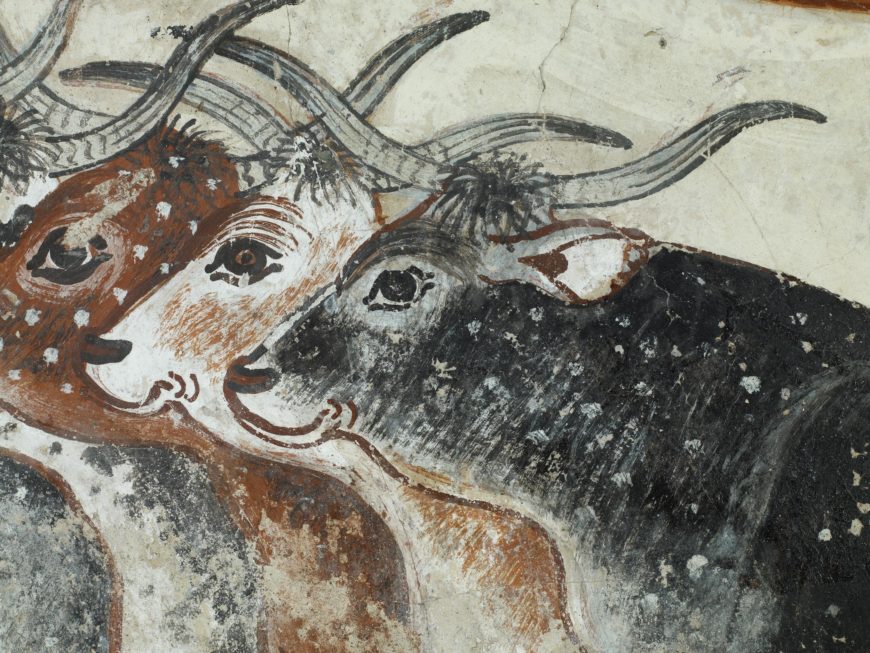
Cattle (detail), Nebamun'due south cattle, Tomb-chapel of Nebamun, c. 1350 B.C.Eastward., 18th Dynasty, paint on plaster, whole fragment: 58.v ten 10.five cm, Thebes, Egypt © Trustees of the British Museum
The herdsman is telling the farmer in front of him in the queue:
Come up on! Go away! Don't speak in the presence of the praised 1! He detests people talking …. Pass on in quiet and in order … He knows all affairs, does the scribe and counter of grain of [Amun], Neb[amun].
The name of the god Amun has been hacked out in this caption where it appears in Nebamun's name and title. Shortly after Nebamun died, King Akhenaten (1352–1336 B.C.Due east.) had Amun's name erased from monuments as function of his religious reforms.
Nebamun's geese
This scene is part of a wall showing Nebamun inspecting flocks of geese and herds of cattle. He watches equally farmers drive the animals towards him; his scribes (secretaries) write down the number of animals for his records. Hieroglyphs describe the scene and record what the farmers say as they squabble in the queue.
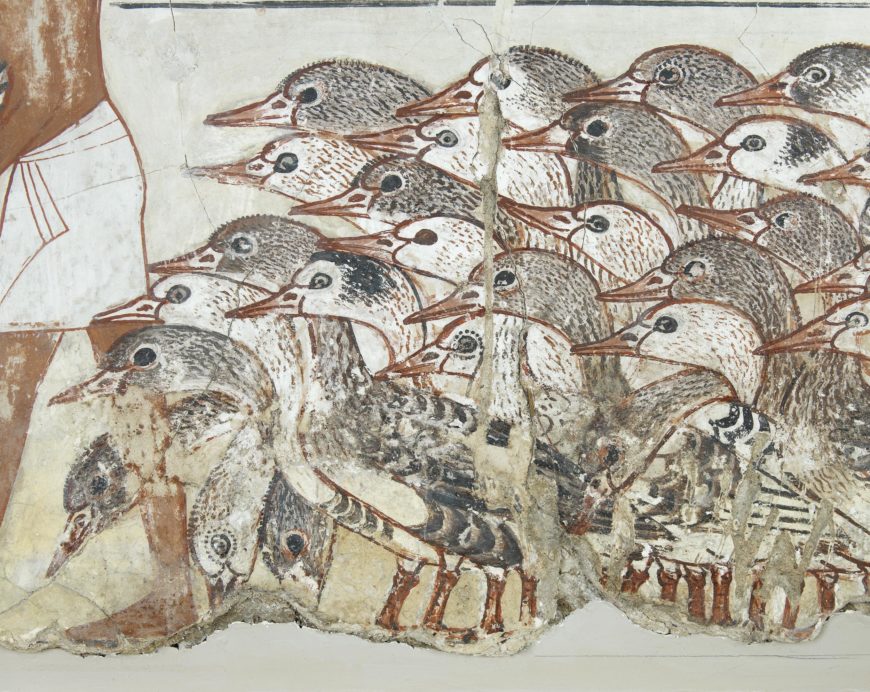
Geese (particular), Nebamun's Geese, Tomb-chapel of Nebamun, c. 1350 B.C.E., 18th Dynasty, paint on plaster, whole fragment: 71 x 115.five cm, Thebes © Trustees of the British Museum
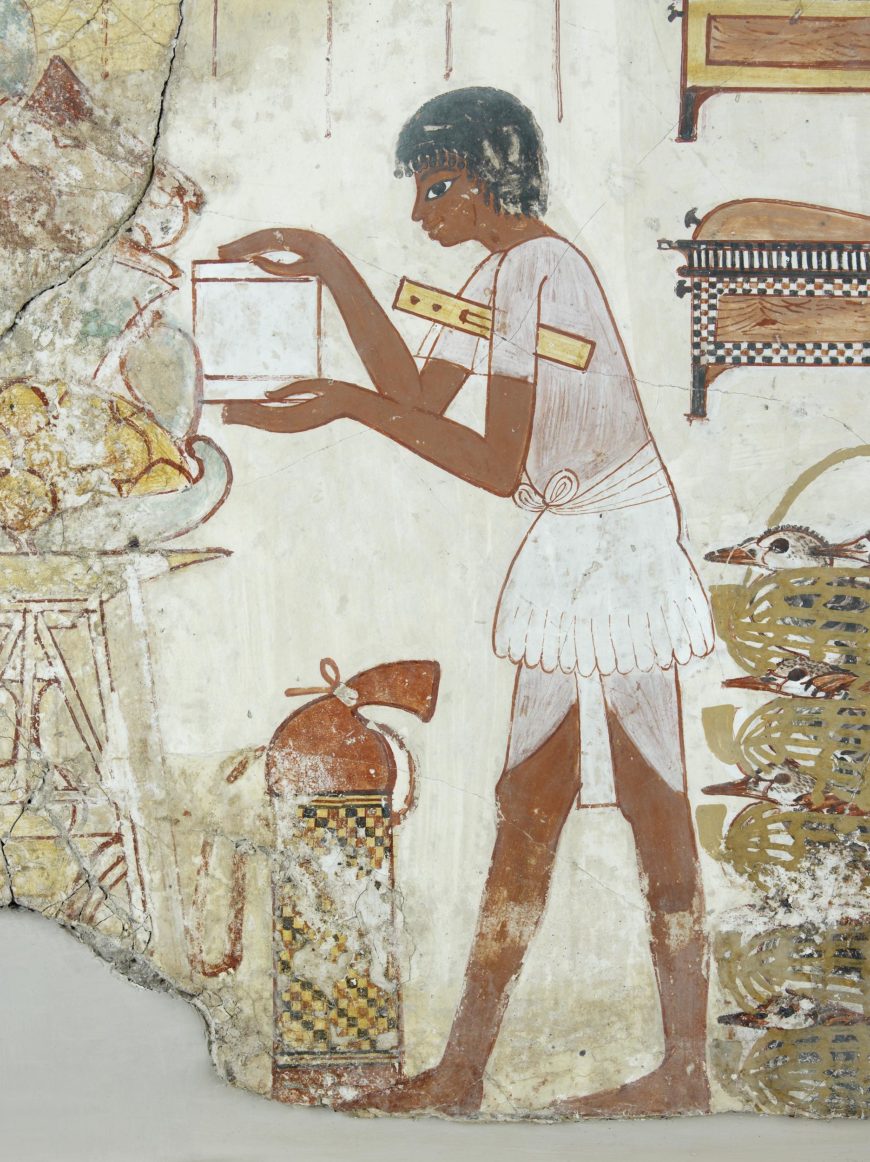
Scribe (particular), Nebamun's geese, Tomb-chapel of Nebamun, c. 1350 B.C.Due east., 18th Dynasty, paint on plaster, whole fragment: 71 ten 115.five cm, Thebes © Trustees of the British Museum
This scribe holds a palette (pen-box) nether his arm and presents a roll of papyrus to Nebamun. He is well dressed and has small rolls of fat on his breadbasket, indicating his superior position in life. Abreast him are chests for his records and a pocketbook containing his writing equipment.
Farmers bow down and make gestures of respect towards Nebamun. The man behind them holds a stick and tells them: "Sit and don't speak!" The farmers' geese are painted as a huge and lively gaggle, some pecking the ground and some flapping their wings.
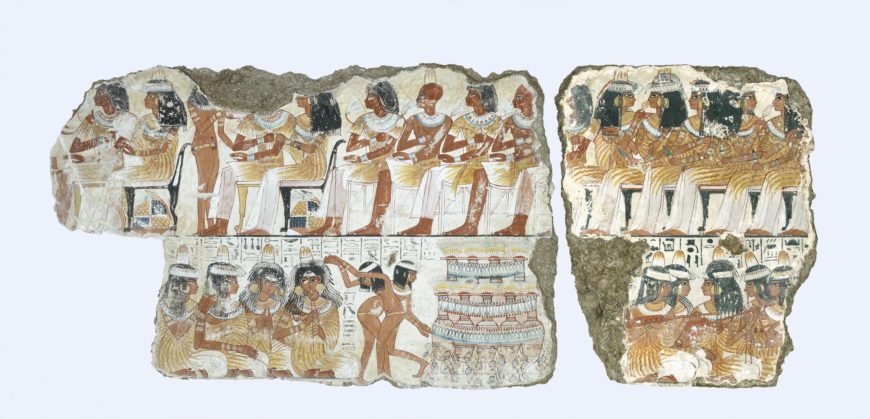
A feast for Nebamun, the top half of a scene from the Tomb-chapel of Nebamun, c. 1350 B.C.E., 18th Dynasty, pigment on plaster, 88 10 119 cm, Thebes © Trustees of the British Museum
A feast for Nebamun (pinnacle one-half)
An entire wall of the tomb-chapel showed a feast in honor of Nebamun. Naked serving-girls and servants wait on his friends and relatives. Married guests sit in pairs on fine chairs, while the young women turn and talk to each other. This erotic scene of relaxation and wealth is something for Nebamun to savour for all eternity. The richly-dressed guests are entertained past dancers and musicians, who sit on the basis playing and clapping. The words of their song in laurels of Nebamun are written above them:
The world-god has caused
his dazzler to grow in every body…
the channels are filled with water anew,
and the land is flooded with love of him.
Some of the musicians look out of the paintings, showing their faces frontally. This is very unusual in Egyptian fine art, and gives a sense of liveliness to these lower-class women, who are less formally drawn than the wealthy guests. The immature dancers are sinuously fatigued and are naked autonomously from their jewelry.
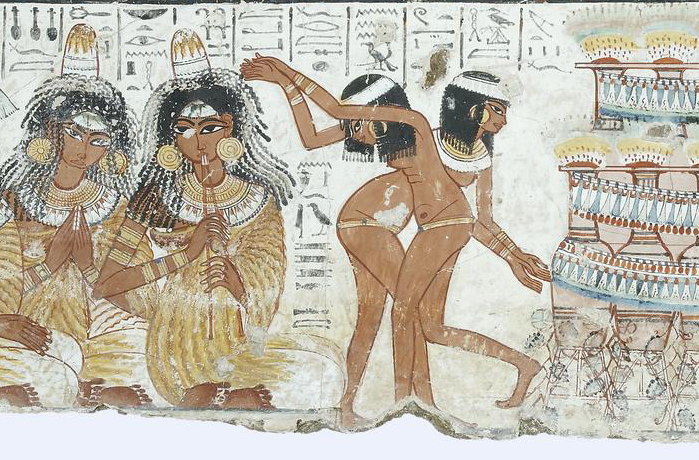
Musicians and dancers (detail), A banquet for Nebamun, Tomb-chapel of Nebamun, c. 1350 B.C.E., 18th Dynasty, pigment on plaster, whole fragment: 88 x 119 cm, Thebes © Trustees of the British Museum
A rack of large wine jars is decorated with grapes, vines and garlands of flowers. Many of the guests too article of clothing garlands and scent lotus flowers. All the guests wear elaborate linen dress. The artists take painted the textile as if it were transparent, to show that it is very fine. These elegant sensual dresses fall in loose folds around the guests' bodies.
Men and women's skins are painted in different colors: the men are tanned and the women are paler. In one place the artists altered the drawing of these wooden stools and corrected their get-go sketch with white pigment.
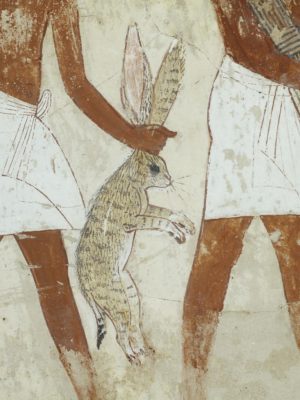
Estate worker bringing a hare from the fields (detail), Servants bringing offerings, Tomb Chapel of Nebamun, c. 1350 B.C.East., 18th Dynasty, pigment on plaster, 41 cm, Thebes, Arab republic of egypt © Trustees of the British Museum
Servant'due south bringing offerings
A procession of simply-dressed servants bring offerings of food to Nebamun, including sheaves of grain and animals from the desert. Tomb-chapels were congenital so that people could come and make offerings in memory of the expressionless, and this a common scene on their walls. The border at the bottom shows that this scene was the lowest ane on this wall.
Ane retainer holds two desert hares past their ears. The animals have wonderfully textured fur and long whiskers. The superb draughtsmanship and composition make this standard scene very fresh and lively.
The artists have fifty-fifty varied the servants' simple clothes. The folds of each kilt are different. With i of these kilts, the artist changed his mind and painted a different fix of folds over his offset version, which is visible through the white paint.
Additional resources
One thousand. Hooper,The Tomb of Nebamun (London, British Museum Press, 2007).
R. Parkinson,The painted Tomb-chapel of Nebamun (London, British Museum Press, 2008).
A. Middleton and G. Uprichard, (eds.),The Nebamun Wall Paintings: Conservation, Scientific Analysis and Display at the British Museum (London, Archetype, 2008).
Explore the tomb-chapel of Nebamun in a 3D interactive animation at The British Museum
© Trustees of the British Museum
Source: https://smarthistory.org/paintings-from-the-tomb-chapel-of-nebamun/

Post a Comment for "Egyptian Art Banquet Scene From the Tombchapel of Nebamun Thebes His Wadi"